In short
Good kitchen lighting uses layers. Recessed lights give general light across the room, pendants light the island and set the style, and under-cabinet lights put bright, shadow-free light on the counters where you actually work. Each layer should be on its own switch or dimmer, with the same color temperature, and planned before the walls and ceiling are closed.
Key takeaways
- One ceiling fixture or a grid of cans cannot light a kitchen well, because your body blocks light from behind you.
- Recessed lights work best placed over the front edge of the counters, not in the middle of the floor.
- Under-cabinet lighting is the task layer that makes the most difference for everyday cooking.
- Keep one color temperature across all layers and put each layer on its own control.
A lot of older suburban kitchens around Dallas–Fort Worth have the same lighting: a fluorescent box or a single fixture in the middle of the ceiling, maybe a few cans added later. The room is bright enough in the middle and dim exactly where you chop vegetables. When you plan new kitchen lighting as part of a remodel, you get the chance to fix that for good.
The idea designers use is layering. Instead of asking one fixture to do everything, you use a few types of light, each with a specific job, and control them separately. It sounds technical, but it is really about putting light where your hands are and letting the rest of the room feel comfortable.
What are the layers of kitchen lighting?
There are three main layers, plus an optional fourth for mood.
| Layer | Job | Common fixtures | Where it goes |
|---|---|---|---|
| Ambient | General light to move around the room | Recessed lights, flush ceiling fixtures | Ceiling, laid out over the work zones |
| Task | Bright, direct light on work surfaces | Under-cabinet LED strips or pucks, focused recessed lights | Under wall cabinets, over the sink and range |
| Decorative | Style and light over the island or table | Pendants, a chandelier over a dining area | Centered on the island or table |
| Accent | Depth, glow and a night light | In-cabinet lights, toe-kick lights, lights above cabinets | Glass-front cabinets, toe kicks, open shelves |
You do not need every layer in every kitchen. A small galley kitchen may only need recessed lights and under-cabinet lights. A large open kitchen with an island usually benefits from all of them, because it has to work for cooking, homework and entertaining.
Natural light counts as a layer too. A window over the sink or a wall of glass facing the backyard changes how bright the kitchen feels during the day, and it affects which way the room looks best at night. West-facing kitchens get strong afternoon sun, which can make a cool white light look harsh after dark by comparison. Note where your windows are and when the room gets direct sun, and plan the electric light to fill the gaps rather than compete with daylight.
Recessed lights: where they belong
The most common recessed lighting mistake is laying cans out in a neat grid across the middle of the ceiling. When you stand at the counter, the light is behind you, and your own head and shoulders throw a shadow onto the work surface.
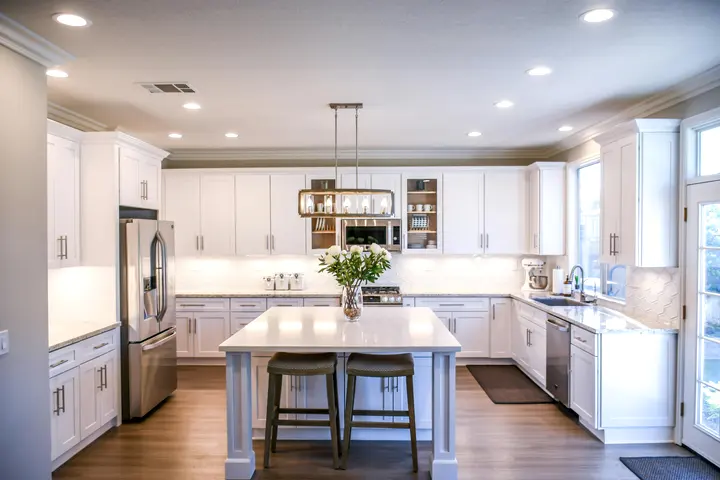
A better layout places the recessed lights over the front edge of the countertops, so the light falls in front of you. Along perimeter cabinets, that commonly means a row running parallel to the cabinets, set out from the wall far enough to clear the upper cabinet fronts. Spacing depends on ceiling height and the fixture's beam, and a good layout avoids both dark gaps and hot spots.
In practice, most kitchens get a few rows of recessed lights: one along each run of cabinets, a few over the island if it has no pendants, and a couple for the walkway and eating area. Modern LED wafer lights are thin and can be installed where there is limited space above the ceiling. In ceilings with an attic above, as in many single-story homes in the area, fixtures need to be rated for contact with insulation and ideally airtight, so they do not leak conditioned air into a hot Texas attic.
Two spots deserve their own light. The sink is where you spend the most time with your back to the room, so a recessed light or a small pendant directly over it is worth planning. The range usually gets light from the hood, but many hood lights are weak. If your hood has dim bulbs, a recessed light just in front of it helps.
How high should pendants hang over an island?
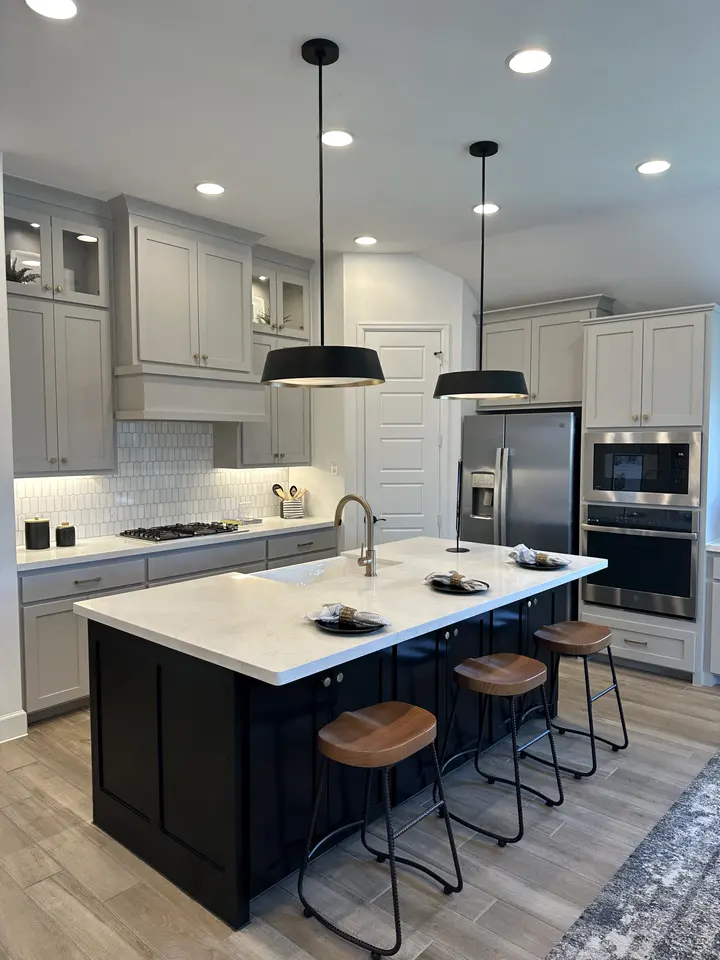
Pendants are the jewelry of the kitchen, but they also have to work. The common guideline is to hang the bottom of an island pendant roughly 30 to 36 inches above the countertop. Taller people and higher ceilings push toward the upper end. The goal is that the pendant lights the counter without blocking anyone's view across the island.
For placement, center the pendants on the countertop, not on the cabinet box underneath, since a seating overhang shifts the center. Two larger pendants suit a shorter island, and three smaller ones often suit a longer one. Leave space at each end so a pendant is not hanging over the edge where people walk.
Pendants alone rarely light an island well enough for serious prep, especially decorative ones with dark or frosted shades. Pairing them with a recessed light or two over the island, or choosing pendants with open bottoms, keeps the work surface bright. For more on how island size and seating affect this, see our custom kitchen islands page.
Under-cabinet lighting: the layer people regret skipping
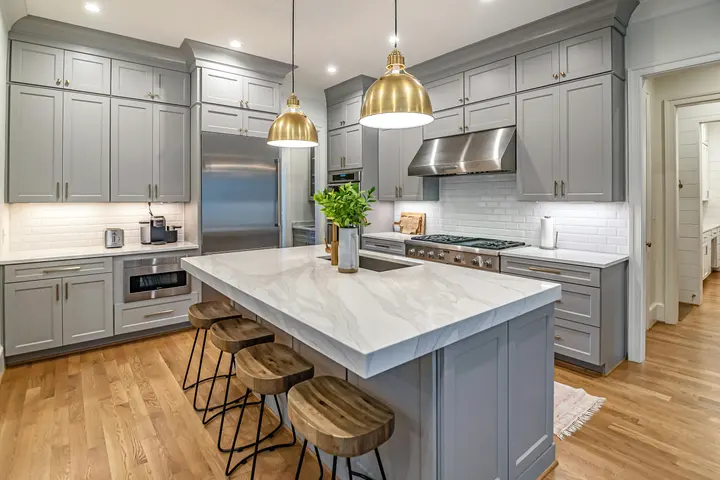
If you add only one layer, make it this one. Under-cabinet lights sit directly above the counter, between you and the work, so nothing blocks them. They also light up the backsplash, which is part of why a new tile backsplash looks so good in finished project photos.
A few details make the difference between good and irritating under-cabinet lighting:
- Continuous light over dots. LED strips in an aluminum channel with a diffuser give an even line of light. Individual pucks can create spots, especially on glossy counters.
- Mount it toward the front. Fixtures placed near the front edge of the cabinet bottom light the counter and backsplash without shining in your eyes when you sit at a table.
- Hide it. A light rail or a slightly recessed cabinet bottom keeps the fixture out of sight from across the room.
- Watch glossy surfaces. Polished stone and glossy tile reflect every diode. Diffused strips avoid the reflection of a row of little dots.
- Plan the power. Hardwired under-cabinet lights need wiring and a driver hidden in a cabinet, which is easiest to plan before the cabinets go in.
We plan backsplash tile and lighting together for exactly this reason, as described on our backsplash and lighting installation page.
Getting kitchen lighting color and controls right
Two decisions tie the layers together: color temperature and controls.
Color temperature
LED light is labeled in Kelvin. Around 2700K to 3000K reads warm and cozy, close to traditional incandescent light. Around 3500K to 4000K reads cleaner and whiter. Most homeowners are happiest in the warm-to-neutral range for kitchens that open to living areas. The key is consistency: mixing a warm pendant with cool recessed lights and bluish under-cabinet strips makes the room look patchy. Also look for a high color rendering index, commonly 90 or above, so food, wood and paint colors look true.
Switches and dimmers
Put each layer on its own switch, and put the ambient and decorative layers on dimmers. That lets you run bright task light while cooking, then dim the recessed lights and leave the pendants glowing when guests arrive. Dimmers need to be compatible with the LED fixtures they control, or you get flicker and buzzing. Think about where switches go too: at each entrance to the kitchen and near the island, not only by one doorway.
When kitchen lighting has to be planned
Lighting is decided during design and installed during rough-in, before drywall and cabinets. That is when ceiling boxes are placed, wires are run to under-cabinet locations, and pendant boxes are centered on the planned island. Changing locations after the ceiling is patched and painted means cutting and repairing it again.
If you are keeping your cabinets, lighting can still be improved. Recessed lights can be added through the ceiling, and plug-in or low-voltage under-cabinet lights can be added with less wiring. The results are rarely as clean as lighting planned with a full remodel, but they are a real improvement over one ceiling fixture.
What to decide before you call for an estimate
Note what you dislike about the current light: shadows on the counters, a dark island, harsh color or no dimming. Decide whether you want pendants over the island and roughly what style. Think about how you use the kitchen at night, since that often drives the accent layer.
Lighting works best as part of a complete plan, which our kitchen remodeling in Dallas–Fort Worth page explains. When you are ready, get a free estimate for your kitchen and we will plan the layers with you.
Questions homeowners ask
How many recessed lights does a kitchen need?
It depends on the size of the kitchen, the ceiling height and the fixtures' beam spread, so there is no single number. Instead of counting cans, plan rows over the front edge of each countertop run, a few over the island if there are no pendants, and enough in walkways and eating areas to avoid dark patches. A lighting layout drawing makes this easy to check.
What is the best kitchen lighting color temperature?
Most homeowners prefer warm to neutral white, commonly around 2700K to 3000K, especially in kitchens that open to living and dining rooms. Some prefer a slightly whiter 3500K for a crisp look. Whatever you choose, use the same color temperature for recessed, pendant and under-cabinet lights so the room looks consistent from every angle.
Can under-cabinet lights be added without replacing cabinets?
Yes. Plug-in and low-voltage LED strips can be added under existing cabinets, with the cords routed through the cabinets to an outlet. Hardwired lights connected to a wall switch look cleaner but need an electrician to run wiring, which is simpler when the backsplash is being replaced at the same time.