In short
Luxury vinyl plank is usually the better fit for kitchens, laundry rooms, busy family areas and homes with large dogs, because it shrugs off spills and is easy to install over a slab. Hardwood is the better fit for living and dining rooms where you want real wood that can be sanded and refinished, and where water is rarely on the floor.
Key takeaways
- Luxury vinyl plank resists water and daily wear, which makes it the practical choice for kitchens, laundry rooms and homes with pets.
- Hardwood can be sanded and refinished, so a well-kept floor can be renewed instead of replaced.
- On a slab foundation, engineered hardwood or LVP is usually the right format, not solid boards nailed to the concrete.
- Many homes end up using both, with LVP in wet and busy rooms and hardwood in the formal rooms.
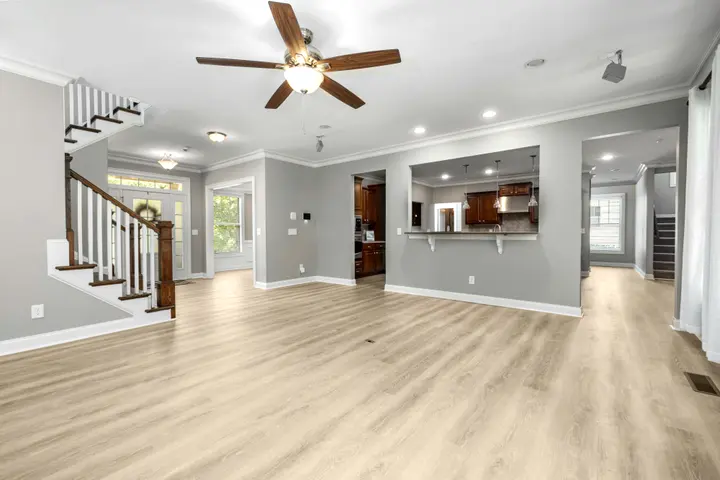
You are standing in a showroom with a plank of luxury vinyl in one hand and a plank of oak in the other, and from three feet away they look almost the same. The question of luxury vinyl plank vs. hardwood is not really about looks anymore. It is about how your household lives on the floor, what is under it, and how long you expect it to last.
In most Dallas-Fort Worth homes the floor sits on a concrete slab, the summers are long and humid outside and dry inside under the air conditioning, and a lot of families have kids, dogs and a back door that opens straight onto the yard. Those details matter more than any sample board.
Luxury vinyl plank vs. hardwood: what is the real difference?
Hardwood is wood. Solid hardwood is one piece of lumber from top to bottom. Engineered hardwood has a real wood top layer bonded to a stable core of plywood or similar layers, which makes it far less prone to swelling and shrinking.
Luxury vinyl plank, usually called LVP, is a layered product. A printed image of wood sits under a clear wear layer, on top of a vinyl or rigid composite core. Most LVP sold for homes clicks together and floats over the subfloor, and many products carry an attached underlayment pad.
That construction drives almost every trade-off that follows. Wood responds to moisture and can be sanded. LVP largely ignores moisture on its surface and cannot be sanded, because the wood grain is only a picture.
How do they handle water, spills and Texas humidity?
This is where LVP earns its place. A dog bowl that tips over, a dishwasher that weeps, wet feet coming in from the pool: the surface of a good LVP floor is not bothered by any of that if you wipe it up. Water that gets under the planks through the edges is a different story, since it can sit on the slab and cause odor or mold, so a leak still needs to be found and dried.
Hardwood does not like standing water. A spill wiped up quickly is fine. A slow leak under the fridge or around a toilet can cup the boards, leaving the edges higher than the centers, and badly swollen boards usually need to be replaced.
Humidity is the quieter issue. Wood takes on and gives up moisture with the air, so it expands in humid months and shrinks in dry ones. Engineered hardwood moves far less than solid. That is why wood flooring is commonly acclimated in the home before installation, why installers leave an expansion gap at the walls, and why keeping your air conditioning running steadily helps the floor stay put.
Which holds up better to kids, pets and daily wear?
For scratch resistance, LVP generally wins in a busy house. Its wear layer is measured in mils, and a thicker wear layer typically lasts longer in high-traffic areas. Large dog claws, chair legs and grit from the patio are all less visible on LVP than on a finished wood floor.
Hardwood does scratch, and dents under dropped pots or high heels, especially softer species. Harder species and a matte or wire-brushed finish hide wear far better than a glossy finish on a smooth board. Plenty of families are happy living with the character that builds up over time.
The difference is what happens after ten years of that wear.
- Solid hardwood can typically be sanded and refinished several times, and each refinish takes the surface back to new wood.
- Engineered hardwood can be refinished too, but the number of times depends on how thick the wood top layer is. A thin top layer may allow only a light screen and recoat.
- LVP cannot be refinished. Once the wear layer is worn through or a plank is gouged, that plank is replaced. With a click floor, a damaged plank near a wall can often be swapped, which is one reason to keep a spare box.
What works on a slab foundation?
Most homes across Plano, Frisco, McKinney, Allen and the rest of the area sit on a slab, and the slab changes the conversation. Solid hardwood is normally nailed down to a wood subfloor, and it is not meant to be nailed or glued directly to concrete. To put solid wood over a slab, you would need a plywood layer fastened over the concrete first, which adds height and cost.
Engineered hardwood is built for this situation. It can be glued directly to a properly prepared slab or floated over an underlayment with a moisture barrier. LVP floats over the slab with its own pad or a separate underlayment, and some products are glued down in commercial style.
Whatever you choose, concrete has to be tested for moisture and checked for flatness before any floor goes down. We cover what that looks like in our guide to flooring installation across Dallas-Fort Worth, and in more depth in the article on choosing flooring for a slab foundation.
The two floors side by side
| Question | Luxury vinyl plank | Hardwood |
|---|---|---|
| Surface water and spills | Very resistant if wiped up | Tolerates quick cleanup, damaged by standing water |
| Scratches from pets | Generally shows less | Shows more, especially glossy finishes |
| Can be refinished | No, planks are replaced | Yes, how often depends on wood thickness |
| On a concrete slab | Floats or glues down directly | Engineered glues or floats, solid needs a wood subfloor |
| Feel underfoot | Slightly softer, can sound hollow if floated on a poor pad | Solid and warm, the sound of a real floor |
| Best rooms | Kitchens, laundry, mudrooms, family rooms, bathrooms | Living, dining, bedrooms, studies |
What drives the cost of each?
The same square footage can be priced very differently from one house to the next, so a flat per-foot number rarely tells you much. What moves the number is easier to explain.
- The product itself. LVP ranges from thin, flexible planks to thick rigid-core planks with a heavier wear layer. Hardwood varies by species, grade, plank width and whether it is solid or engineered.
- Removal of the old floor. Pulling carpet is quick. Breaking up glued-down tile on a slab takes more labor and leaves more patching to do.
- Subfloor preparation. Grinding high spots and pouring self-leveler in low spots can be a real part of the job, especially on older slabs.
- Installation method. A floating click floor installs faster than glue-down engineered wood, and site-finished hardwood adds sanding and finish coats with drying time between them.
- Trim, stairs and transitions. Baseboard removal and reinstallation, stair treads, and thresholds between rooms all add time.
A written estimate should break these out so you can see where the money goes. Ours does, and it is free.
Can you use both in the same house?
Yes, and many homeowners do. A common plan is LVP through the kitchen, breakfast area, laundry and back hallway, with hardwood in the formal living and dining rooms, or in the bedrooms upstairs. The trick is to plan where the change happens.
Good places for a transition are doorways, a cased opening, or a clear line such as the edge of a kitchen. Bad places are the middle of an open room, where a threshold strip becomes a trip line and the two floors are compared side by side all day. If your kitchen, dining and family room are one open space, one continuous floor usually looks better.
Before you commit, bring samples of both home and lay them next to each other in the actual rooms, in daylight and at night. Two wood tones that look close in a showroom can clash in your light.
A quick way to decide by room
- Kitchen, laundry, mudroom and anything next to the back door: lean LVP or tile.
- Bathrooms: LVP or tile, not hardwood.
- Formal living and dining rooms with little water exposure: hardwood if you want real wood.
- Bedrooms: either works, so it comes down to feel, budget and how the room connects to the rest of the house.
You can see more on each option on our pages for luxury vinyl plank installation and hardwood and engineered wood floors.
What to decide before you call for an estimate
You do not need to have picked a product. It helps to know a few things so the visit is useful.
- Which rooms are included, and whether the floor should run continuously between them.
- Who lives on the floor: pets, small children, anyone who needs a softer or quieter surface.
- Do you want a floor you can refinish later, or one you would replace?
- What is there now, so we know what comes up and what the slab or subfloor may look like underneath.
We will measure, check the subfloor, and give you a written price for each option you are weighing. When you are ready, schedule your free flooring estimate and we will come out to look at the rooms in person.
Questions homeowners ask
Is luxury vinyl plank vs. hardwood a big difference in resale appeal?
Buyers in many neighborhoods expect hardwood or a quality wood-look floor in the main living areas, and a good LVP floor is widely accepted. What hurts resale more is a worn, mismatched or poorly installed floor of any type. A consistent floor through the main rooms usually matters more than the material.
Can I put hardwood in a kitchen?
You can, and many older homes have it. It needs quick cleanup of spills and attention to leaks around the sink, dishwasher and refrigerator. If your kitchen sees a lot of water, dogs or kids, LVP or tile will be less worry. If you choose wood, engineered hardwood is usually the steadier option over a slab.
Does LVP feel cheap underfoot?
A thin, flexible plank over a poor pad can feel hollow and sound clicky. A thicker rigid-core plank over a proper underlayment on a flat subfloor feels much more solid. Flatness matters most, because gaps under a floating floor are what make it flex and sound hollow.
How long does it take to install either floor?
It depends on the area, the removal and how much subfloor preparation is needed. A floating LVP floor in a few rooms often goes quickly once the subfloor is ready. Glue-down engineered wood takes longer, and site-finished hardwood adds sanding and drying time between finish coats.