In short
For most shower walls, porcelain is the practical choice: it is dense, barely absorbs water, needs no sealing and shrugs off most cleaners. Natural marble offers depth and veining no print can fully copy, but it is softer, porous and etches from acidic products, so it needs sealing and gentler care. Marble-look porcelain splits the difference.
Key takeaways
- Porcelain is dense and low-maintenance; marble is porous, softer and reacts to acids.
- Marble needs periodic sealing and pH-neutral cleaners, and still etches if the wrong product touches it.
- Large-format marble-look porcelain gives a similar look with fewer grout lines and far less upkeep.
- A common compromise is porcelain on the shower walls and real marble on a vanity top, niche or accent.
You have seen the photos: a shower wrapped in white marble with soft gray veins, and next to it a nearly identical shower that turns out to be porcelain. Up close they differ, and after a few years of daily showers they differ even more.
Choosing porcelain vs. marble for shower walls is less about which looks better on the first day and more about how you want to live with the shower. Here is how the two materials behave in a wet room, what each asks of you, and where each one makes sense.
Porcelain vs. marble for shower walls: how the materials differ
Porcelain is a manufactured tile. Fine clay and minerals are pressed and fired at very high temperatures, which makes the body dense and hard, with very low water absorption. The look, whether plain, concrete-like or marble-like, is printed or glazed onto the surface.
Marble is quarried stone. It is mostly calcite, a mineral that is softer than porcelain, more porous, and chemically sensitive to acids. Every slab and tile is different, with veining that runs through the stone rather than sitting on top of it.
Those two facts, density and chemistry, explain almost every practical difference that follows. The table below sums them up before we go through the ones that matter most in daily use.
| Factor | Porcelain | Natural marble |
|---|---|---|
| Water absorption | Very low | Porous; absorbs without sealing |
| Reaction to acids | None | Etches, leaving dull spots |
| Sealing | Not needed for the tile | Needed, and reapplied periodically |
| Cleaning products | Most bathroom cleaners are fine | pH-neutral, stone-safe products only |
| Look | Printed pattern, can repeat across tiles | Unique veining and depth in every piece |
| Sizes | Wide range, including very large formats | Common tile sizes and slabs |
| Installation | Needs flat walls; large pieces are heavy | Needs flat walls, careful layout and white thinset for light stone |
| Replacement match | Close within a product line | Hard to match exactly |
What happens to marble in a shower over time?
Marble can last a lifetime in a shower, but it changes as it is used, and not everyone likes how it changes.
Etching
Acids react with calcite and leave dull, slightly rough spots called etch marks. In a shower, the usual culprits are acidic cleaners, vinegar-based cleaning tricks, some shampoos and body washes, and certain hard-water removers. Etching is not a stain; sealer does not prevent it. On polished marble it shows as a dull patch, while honed marble hides it better.
Staining and darkening
Because marble is porous, it can absorb water, soap residue and minerals. Oils and colored products can leave marks, and hard water can build up in the surface. A good penetrating sealer slows this down, but it needs to be reapplied periodically, and you have to keep an eye on it.
Daily care follows from that. A marble shower does best when it is squeegeed or wiped dry after use, cleaned with a pH-neutral stone cleaner, and kept away from bleach, vinegar and bathroom sprays that promise to dissolve soap scum. Bottles are best kept in a niche or on a caddy rather than left on a marble ledge, where rings can form under them.
Scratching
Marble is softer than porcelain, so abrasive pads and gritty cleaners can scratch it. On walls this matters less than on floors, but a shower bench or niche shelf takes more wear than a vertical wall.
Some homeowners enjoy the patina that develops. Others see every mark as damage. Knowing which camp you are in is the most useful part of this decision.
Why is porcelain easier to live with?
Porcelain's dense body means water and soap stay on the surface. It does not need sealing, it does not etch, and it tolerates most bathroom cleaners. Day-to-day care is a squeegee after showering and a regular wipe-down.
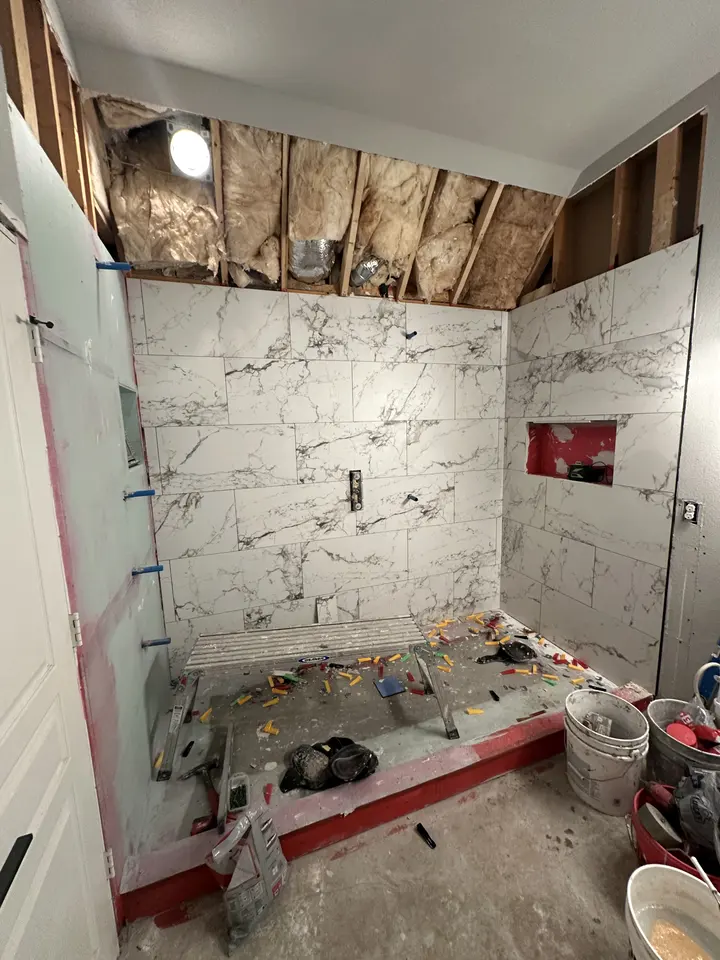
The grout is the only part of a porcelain shower that needs attention, and with large-format tile there is much less of it. That is one reason our own shower builds commonly use large-format porcelain, often in marble-look finishes, over a waterproofing membrane on cement board. Big panels, few joints, and nothing that reacts to the wrong bottle of cleaner.
Porcelain also stays consistent. If a tile cracks years later, a replacement from the same product line will be close, where a replacement piece of natural marble may not match the veining or color of what is on the wall.
Can marble-look porcelain really pass for marble?
From across the room, often yes. Up close, a few things give it away. The pattern is printed, so on a large wall you may spot the same vein repeating every few tiles. The veining sits in the surface rather than running through the body, and a cut edge shows the tile body, not stone.
Good manufacturers offer many different faces within one product, which reduces repetition, and a careful installer lays the tiles out before setting them to spread similar faces apart. Large-format panels help the most, because fewer, bigger pieces mean fewer places for the repeat to show and fewer grout lines interrupting the veining.
If the look of real stone matters to you, the honest answer is that nothing fully replaces it. If what you want is a light, veined, calm shower that stays that way with little effort, marble-look porcelain gets you there.
Finish is worth a look too. Marble-look porcelain comes in polished, satin and matte surfaces. Polished porcelain reflects light like polished stone and suits walls well, while a matte or textured version belongs on the shower floor, where grip matters more than shine. Pairing a polished wall with a matte floor in the same pattern is a common way to keep the look consistent without making the floor slippery.
What does each take to install well?
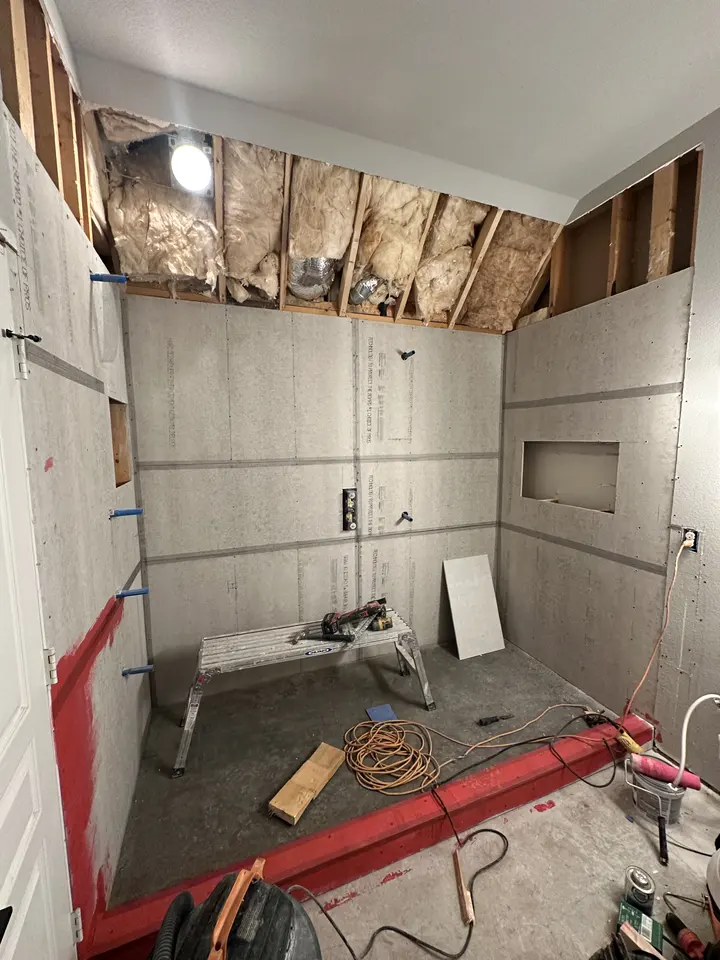
Both materials need flat, properly waterproofed walls. Large tiles show every wave in the wall, so the backer board and framing are checked and corrected before tile goes on. Large pieces are also back-buttered, with thinset on the back of the tile as well as the wall, to get full coverage.
Marble adds a few steps. Light-colored marble is set in white thinset, because gray thinset can show through translucent stone. Tiles or slabs are often dry-laid first to arrange the veining. Some stone needs sealing before grouting so the grout does not stain it. None of this is exotic, but it takes time.
Grout choice matters with polished marble as well. Stone is often set with tight joints, and a gritty sanded grout worked across a polished face can leave fine scratches, so the grout and the method are chosen with the stone in mind. Because of these extra steps, and because the stone itself tends to be the pricier material, a real marble shower usually costs more to build than a porcelain one of similar size and layout. Premium large-format porcelain panels narrow that gap, since they need their own careful handling and setting.
For both, the tile is only the visible layer. What sits behind it, cement board, a continuous membrane and a floor sloped to the drain, is what keeps the shower dry. Our page on custom tile showers and frameless glass shows how the layers come together.
Is there a middle ground?
Yes, and it is a common and sensible compromise. Put porcelain where water hits every day, and use real marble where it gets less abuse and more attention. A few ways that works:
- Marble-look porcelain on the shower walls and floor, with a real marble vanity top.
- Porcelain walls with a marble mosaic on the back of a recessed niche.
- Porcelain in the shower and a marble accent wall behind the vanity, outside the splash zone.
- Porcelain on the shower floor, where slip resistance and hard wear matter most, even if the walls are stone.
The same thinking applies to floors. If you are weighing materials for the rest of the bathroom, our page on porcelain and stone tile floor installation covers what works underfoot.
What to decide before you call for an estimate
Start with honesty about maintenance. If sealing a shower and checking every cleaner label sounds fine, marble is a real option. If you want to squeegee and forget it, porcelain is the better fit. Then decide how large you want the tiles, since size affects layout, grout lines and how flat the walls need to be.
Bring samples or photos if you have them, and note whether the look you like is polished or honed. For the bigger picture of what a full bathroom project covers, see our Dallas bathroom renovation services. When you are ready to talk through materials in your own space, get a free estimate for your shower.
Questions homeowners ask
Is marble or porcelain better for shower walls in a busy family bathroom?
Porcelain is the safer choice for a bathroom used by several people every day. It does not etch or need sealing, and it tolerates the cleaners and products a family tends to bring into a shower. Marble can work, but it needs consistent care, and one acidic cleaner used by the wrong person can leave marks that are hard to remove.
How often does a marble shower need sealing?
There is no single schedule, because it depends on the stone, the sealer and how much the shower is used. A simple check is to put a few drops of water on the marble; if it darkens quickly, it is time to reseal. Follow the sealer maker's guidance and use only stone-safe, pH-neutral cleaners between applications.
Does honed marble hold up better than polished marble in a shower?
Honed marble hides etching better, because its matte surface does not show dull spots the way a polished finish does. It still etches and still needs sealing, and its open surface can hold soap residue a little more. Many homeowners who choose marble for a shower prefer honed for that reason, accepting a softer look.